
Where Did It Go?
Searching for evidence of a checkered recording career

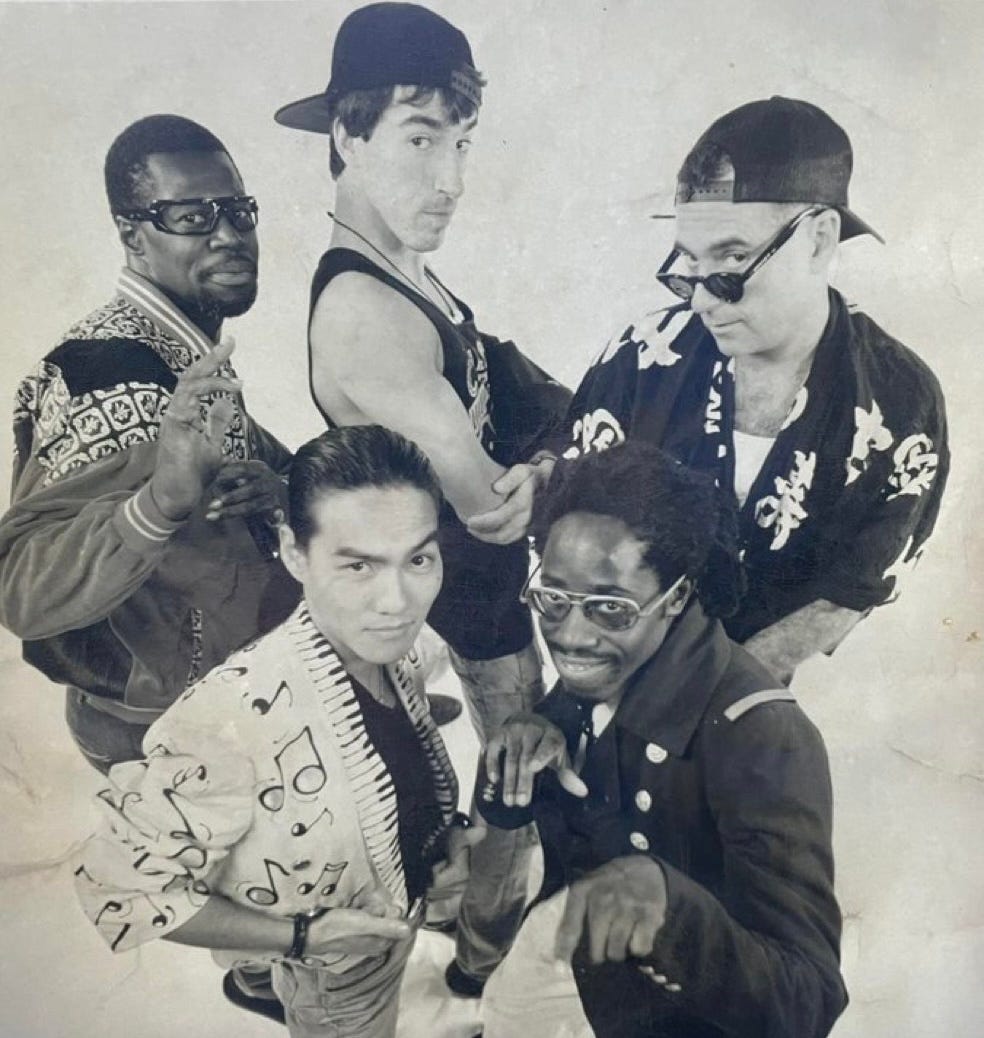
Music is an ephemeral thing, despite all the efforts over the past 150 years by inventors, manufacturers, producers, engineers, music business people and musicians themselves to record everything onto physical and electronic media for whomever and whatever remains as “posterity.” It’s pretty fucking unlikely that any of the records, CDs, tapes or digital sound files made by me and my ilk, not to mention the sensitive contrivances that allow humans to hear these works, will endure for 5,000 years. Something may be dreamed up to more effectively maintain all of these confections and their means of performance into the deep future, but, judging by the dearth of anything left to us from remote antiquity that wasn’t carved into or painted on a rock, I’m not optimistic.
Much of the music I’ve dreamed up and/or participated in over nearly 60 years has been recorded in every manner known to modernity: by producers in major label-financed studios in New York and L.A., in live venues from intimate clubs to arenas, in small and medium-sized studios of four, eight, sixteen and 32 tracks, in home studios, after hours in a closed Radio Shack (RIP), and in my own basement using nothing but an iPhone, my old Mexican Strat, a Fender Precision bass and a couple of ancient keyboards. Things I’ve done can still be heard on out-of-print records, tapes and CDs, and all over the Internet if you know where to look.
https://on.soundcloud.com/f5bwA3pfaPzuTGHZoV
https://on.soundcloud.com/l3w6VvBkyyhWKZ2RCL
For now, anyway.
With the apparently inexorable incursion of “artificial intelligence” paradigms into this Byzantine early 21st-century musical world, the landscape is changing, fast, spurring me to begin paying a little more attention to whatever “legacy” I might imagine for myself. The works I and my fellow music creators have left in the electronic memory hole over our lifetimes have become fodder for any hobbyist with a laptop to purloin for their use, or misuse, without acknowledgment or recompense. It’s also now possible for songwriting, performing and recording rights organizations like ASCAP and BMI to utilize AI in searching across every digital platform for financial opportunities to benefit the people who made and continue to make the music.
As a direct result of all this, I suddenly have been reminded of sessions I did long ago, which have been hiding in camouflaged sight for years, avoiding any minimum efforts of mine to get royalties for services rendered.
As part of what is turning out to be a late-innings personal musical renaissance of sorts, I’m taking action to collect on some of it. We’ll see how it goes. I’m trying to hurry, before the apocalypse fucks everything up.
First off, there’s this:
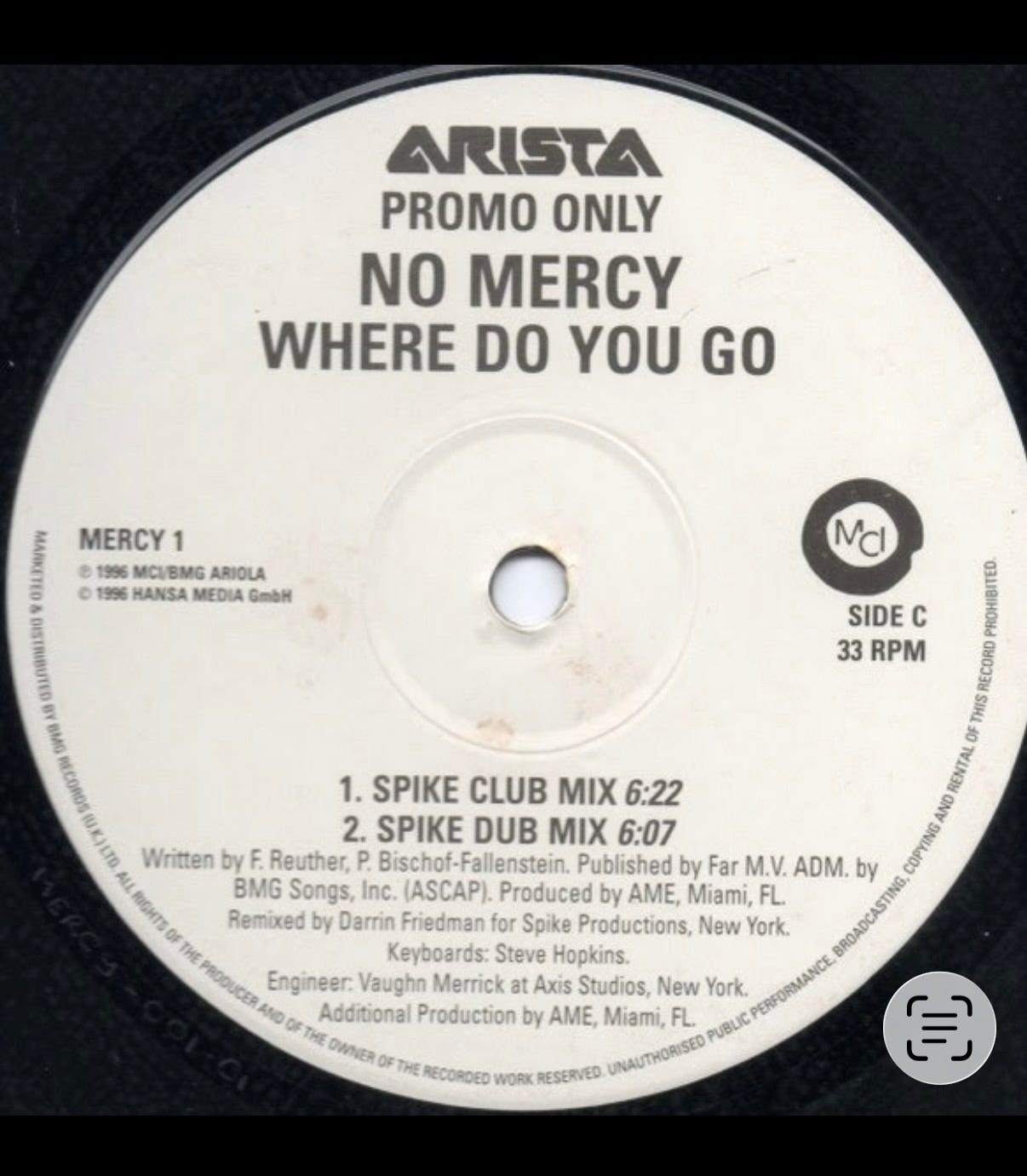
One thing I regularly fail to include in my musical resume is that I have a very short and ironically successful (and, until a couple of weeks ago, I had assumed, anonymous) track record as a dance music producer. Sometime in 1995 or 1996 I was paid $400 cash to record two tracks at Axis Studios in NY for the producer Darrin Friedman, working with a disembodied Europop group called No Mercy. This was around the time I left the band Milo Z. There was no contract, and I can’t remember who recommended me for the gig.
With sampled drum tracks and swatches of samples of the singers that had allegedly been recorded in France … discrete snippets of which were linked to the separate keys of a synthesizer … I had to figure out the changes, construct each song and make up/record keyboard and bass parts. I had not heard a full recording of the thing. The song was called “Where Do You Go,” and one version of it later turned out to be a huge pop/dance hit in the U.S.
I first heard it on the radio a year after the session, and only the words and vocals sounded familiar to me. The versions I played keyboards on (actually produced physically, as the whole daylong session had me playing and constructing all the parts out of my head at the time and freelancing two completely different compositions) turns out to have been the “Spike Club Mix” and “Spike Dub Mix”, which, formatted onto a single, went platinum in the UK, the Netherlands and Germany after dominating in dance clubs.
I had no clue that my name (actually Steve Hopkins … Biff Thuringer is a longtime alias) was credited on the single as “keyboards”. Until two weeks ago.
This revelation was only possible because my composer son JS Hopkins and his lovely wife/manager Emily had been working on getting him paid for all the credited work he’s done. As they still love me and remembered me talking about this session and others, they took a crack at verifying my participation in some of the works I’ve ignored over the years, and this is their first attempt at what might be the tip of a pretty lucrative iceberg.
I can’t really say I’m “proud” of this 8-hour flurry of work, but it does move somewhat … especially the “Dub Mix” track:
Here’s a link to the more pedestrian “Club” mix:
At the same time, my clever spawn will be helping get recompense for the writing and performing credits I and my bass player and friend Joe Copeland may have missed from the 1994 Mercury Records release of the Milo Z album “Basic Need to Howl.”
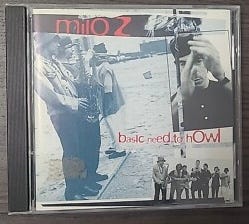
I know one or two of the songs had lives in TV shows and movies at the time, and I also know the song splits registered with BMI might have been a little janky, maybe getting doubly entered and glommed upon by Milo’s publishing company. I only really care about what happened with a couple of tunes: my own “I Know You Want Me” (which Tom Jones apparently had the hots for) and a gorgeous thing called “Love Song” that I co-wrote with Milo and the late Donnear Missouri (aka Mo Holmes).
Just listen, while you still can. Mo’s vocal fucking kills, as does Masa Shimizu’s scathing guitar solo:
If any of this bears fruit at all, I’ll also be setting sights on what happened to a session I did in the early 1980s, recording five or six of my songs at Producer’s Workshop in L.A., the site of classic recordings like Pink Floyd’s “The Wall” and Steely Dan’s “Aja.” The producer/engineer, who was an assistant at the studio at the time, was trying to sign me to a production deal in which he’d get control of the publishing. Before I refused to sign this shitty contract, we pumped out the tunes over a week, with me on keyboards and vocals, Wade Short (Dionne Warwick’s musical director) on bass and Gary Ferguson (Eddie Money, Cher, Olivia Newton-John) on drums. The producer, who for the time being shall remain nameless, allegedly paid assorted studio musicians in cocaine. Everything sounded like Toto or the fucking Eagles, and I left the masters in L.A., unfinished. The producer has gone on to have a bit of a career, and I’m wondering if he ever did something surreptitiously with those tapes.
Another set of sessions nearly lost to the memory hole are the ones I did with my friend Jack Maeby at Arabellum Studio (RIP, to the studio and its legendary proprietor, Art Snay), all during the mid 1970s. One bit of fluff, which predated similar sounding stuff being done by Steely Dan, Pablo Cruise and others dabbling in jazz-influenced pop, managed to get onto local radio in the Albany market for a little bit, before disappearing in some unemployed deejay’s box:
https://on.soundcloud.com/ZjLmtqMHHsK7a15Mq3
Another song of mine, which I continue to fantasize might be covered by somebody into a mega-hit so as to finance my offspring for a spell, was sung in the studio by Tony Lindsay, who went on to a solid career as the vocalist for Santana during the band’s phoenix-like “Supernatural” run starting in the late ‘90s:
https://on.soundcloud.com/Srm4YXj0eoFV83zXiW
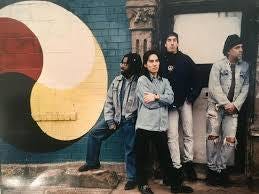
At any rate, until now I’ve resisted putting too much of my ancient work out on streaming platforms like Spotify and YouTube. That’s about to change, as I’ve started another band, featuring Joe Copeland on bass and vocals and a great drummer, Joe Fulginiti, and am recording again. Some of it will be done with the participation of my good friend and former sax player from the Milo Z band, Zé Luis Oliveira, who owns the fabulous Grammy-nominated Atelier Music Studio in Long Island City.
Again, we’ll see how it goes.
I am aware that none of this will last forever. I’m really just doing it to hear it and get that elusive Cadillac of dopamine boosts, helping me enjoy this transitory life a little deeper, in the moment.
Writing shit like this helps too, sometimes. Meanwhile, for most of the time I’m staying close to and trying to help those I love, day to day.
And, occasionally, stopping for a bit to ignore all the BS swirling around on this troubled planet, to just sit and listen to a tune on a decent set of headphones and get some peace of mind …
https://on.soundcloud.com/9qSFUuPUbX6R3wUk33
Loved your soundcloud songs biff
Dolla Dolla Bill Y'all! https://youtu.be/PBwAxmrE194?si=neswR9EyJtM8U9Pt